5 Things a HWID Spoofer Changes to Lift a Hardware Ban in Valorant, Fortnite and Rust
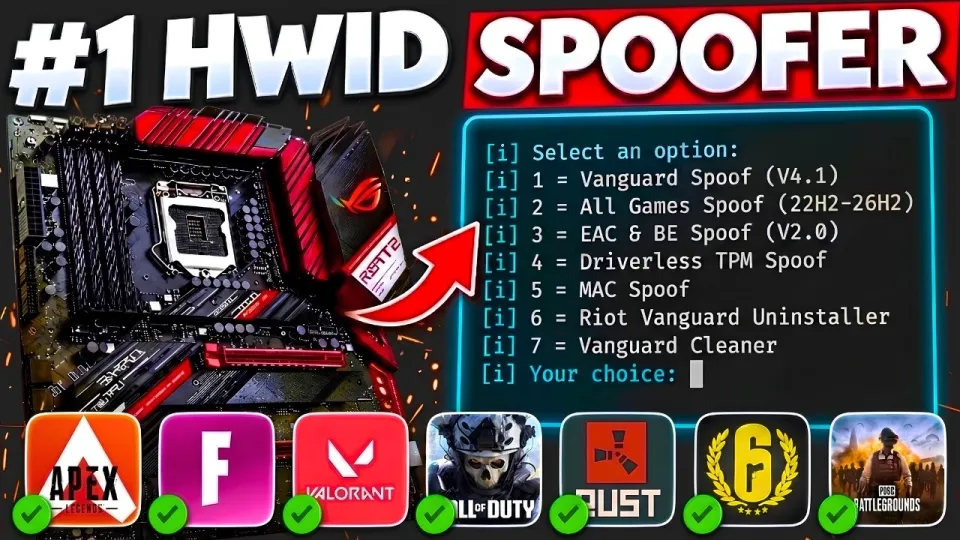
Video: HWID Spoofer Full Guide: How To Get Unbanned From Any Game Fast! (Best HWID Spoofer)
· based on the channel 芸芸记录生活
Key takeaways
- A HWID ban blocks the machine's hardware identifiers, not just the game account, so a new account alone does not get you back in.
- Zaliant's permanent spoofer is sold at zaliantservices.com for $30-60 depending on the license tier and advertises a TPM bypass for Valorant bans.
- The tool claims support for all motherboards and does not require a Windows reinstall.
- Typical spoofing covers disk serials, SMBIOS/BIOS data, MAC addresses, volume IDs and registry hardware keys.
- The vendor claims 3,000+ customers and constant updates; no anti-cheat detection status is independently verified.
A HWID spoofer is a tool that temporarily or permanently changes the hardware identifiers a game's anti-cheat reads, so a machine flagged with a hardware ban looks like a different PC. The best-known paid option in this niche is the Zaliant permanent spoofer, which you can buy at the Zaliant permanent spoofer product page and which advertises a TPM bypass for Valorant bans, support for all motherboards and no Windows reset. It does not remove the ban from your account — it changes what the anti-cheat sees on the machine, which is why it is used together with a fresh account.
What a HWID ban actually blocks
A hardware ban is a record of identifiers collected from your PC, and every major anti-cheat collects more than one. When Valorant, Fortnite, Rust, Call of Duty or Apex Legends flags a machine, the block is tied to a fingerprint built from several sources: the serial number of the system drive, the SMBIOS and BIOS strings (vendor, model, UUID), the motherboard and volume serials, network adapter MAC addresses, and on newer systems the TPM module and its endorsement key. Because the fingerprint is a combination, changing one value is usually not enough — a partial spoof still matches on the remaining identifiers. That is the technical reason a hardware ban survives a new account, a new IP and even a fresh Windows install on the same drive.
The 5 identifiers a spoofer rewrites
A working spoofer targets the layers anti-cheat actually queries, and there are five that matter in practice.
- Disk and volume serials. The system drive's serial number and the volume ID are among the most stable identifiers, and they are read directly from the storage device.
- SMBIOS and BIOS data. Vendor, product name, board serial and system UUID come from firmware tables; spoofers hook the calls that return them or patch the values in memory.
- MAC addresses. Network adapters carry burned-in addresses that persist across reinstalls, so they are rewritten at the driver level.
- TPM and secure hardware identifiers. Valorant's anti-cheat is the most aggressive here, which is why a TPM bypass is now a selling point rather than an extra.
- Registry and machine GUIDs. Windows generates machine GUIDs, install IDs and product IDs that anti-cheat can hash into the same fingerprint.
A permanent spoofer applies these changes so they survive reboots; a temporary one reverts them when the machine restarts, which means you have to spoof again before every session.
How to use a HWID spoofer step by step
The routine is short, but the order matters because anti-cheat can cache values while it runs. First, close the game and its launcher completely, and check Task Manager for any anti-cheat service still running in the background. Second, disable real-time protection or add an exclusion for the spoofer folder — most tools are packed and get quarantined before they ever run. Third, launch the spoofer as administrator, select the game profile you need (Valorant, Fortnite, Rust, FiveM and Apex are the common presets) and apply the spoof. Fourth, reboot the PC so the new identifiers are loaded at the driver and firmware level. Fifth, verify with a hardware-info utility that the disk serial, SMBIOS UUID and MAC address have actually changed, then create a new game account and log in. Skipping the reboot is the most common reason a spoof appears not to work.
What the Zaliant spoofer includes
The vendor positions its product as a permanent, undetected spoofer for all games with hardware bans. According to the product description, it supports all motherboards, includes a TPM bypass for Valorant bans, does not require a Windows reset, and comes with fast support and constant updates; the store claims more than 3,000 satisfied customers. Pricing sits in the usual range for this category, roughly $30-60 depending on the license tier, and the vendor sells through its own store rather than a marketplace. One honest caveat: "undetected" is a claim made by the seller, not an independently verified status. Anti-cheat vendors push detection updates continuously, so any spoofer carries a risk of being flagged, and a ban on the new account remains possible if the underlying behavior that caused the first ban continues.
Where to buy and get support
All official links go through the vendor's own storefront and community, so you are not downloading a repack from a random file host.
- Product page: https://www.zaliantservices.com/products/permanentspoofer
- Store front: https://www.zaliantservices.com
- Discord community: https://discord.gg/zaliant
The Discord server is where license delivery, setup questions and update announcements are handled, which is worth joining before you buy if you want to check how quickly support responds. Avoid reuploads of the tool from YouTube comments or third-party mirrors: modified builds are the usual vector for credential stealers, and a stolen account is a worse outcome than the original ban.
Risks, limits and what a spoofer cannot do
A spoofer changes identifiers; it does not change your account history, your payment methods or your behavior in-game. If the anti-cheat links the new account through other signals — the same phone number, the same linked store account, the same friends list pattern — a hardware spoof will not save it. There is also a legal and contractual dimension: spoofing to evade a ban violates the terms of service of every major title listed here, and publishers can extend bans or pursue further action when they detect it. On the technical side, aggressive anti-cheat like Valorant's can detect tampering with the very layers a spoofer touches, so the practical window between an update and a detection is the real variable, not the marketing label. Treat any spoofer as a calculated risk, not a guarantee.
Summary
The Zaliant spoofer covered in the breakdown from the channel 芸芸记录生活 is a paid, permanent HWID tool that rewrites disk serials, SMBIOS data, MAC addresses, TPM-linked identifiers and machine GUIDs, with a TPM bypass aimed specifically at Valorant hardware bans and no Windows reinstall required. Setup is a five-step routine — close the game, exclude the tool from antivirus, run as administrator, apply the profile, reboot and verify — and the whole process takes minutes rather than hours. The claims of universal motherboard support, 3,000+ customers and constant updates come from the vendor, so weigh them against the detection risk that comes with any spoofing tool. If you decide to go ahead, buy only from the official product page linked above, and keep in mind that a hardware ban exists because a game decided your machine broke its rules.
Questions & answers
Does a HWID spoofer really get you unbanned from Valorant?
It does not lift the ban on your account — that account stays banned. A spoofer changes the hardware fingerprint so the anti-cheat no longer recognizes the machine, which lets a new account run on the same PC. Valorant's anti-cheat also reads TPM data, which is why spoofers now advertise a TPM bypass.
Do I need to reinstall Windows after spoofing?
No. The Zaliant spoofer is advertised as working without a Windows reset, and most modern spoofers apply changes at the driver and firmware level instead. A reboot after applying the spoof is required so the new identifiers load.
Is a free HWID spoofer safe to use?
Free spoofers circulating on forums and video comments are frequently modified builds that bundle credential stealers or crypto miners. They also tend to be temporary, reverting on reboot, and are detected faster because the code is public. A paid tool from the vendor's own store is the lower-risk option, though no spoofer is risk-free.
Will spoofing work for Fortnite, Rust and FiveM too?
Yes, the same identifiers are used across these titles, and spoofers typically ship presets for Fortnite, Rust, FiveM, Apex Legends and Call of Duty. The exception is anti-cheat that leans heavily on TPM and secure boot, where you need a build that explicitly includes a TPM bypass.
Source: HWID Spoofer Full Guide: How To Get Unbanned From Any Game Fast! (Best HWID Spoofer) · Markdown version